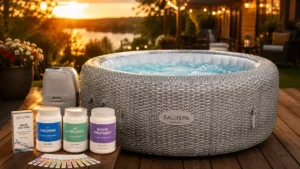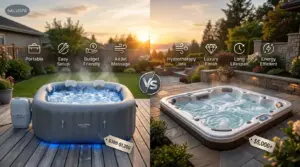
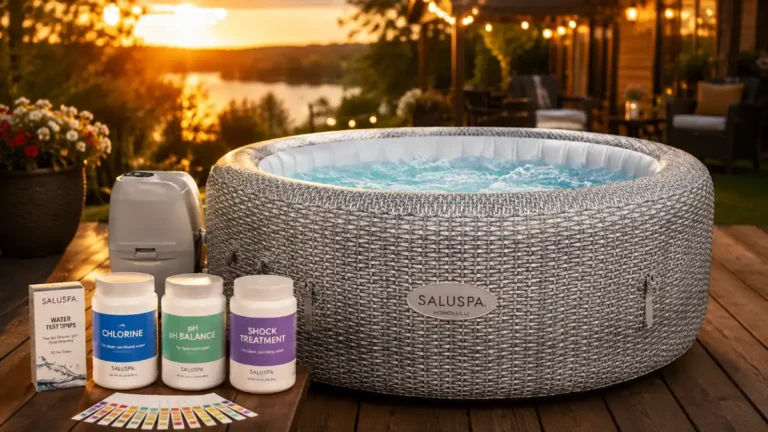
Hot tub chemicals sound more complicated than they actually are. Most of what confuses new owners comes down to five things sanitizer, pH, alkalinity, shock, and the occasional clarifier and once you understand what each one does, keeping your water clean stops being a guessing game.
This guide breaks each of those down, along with the mistakes that cause most of the cloudy-water complaints we hear about.
Why Water Chemistry Actually Matters?
Warm, still water is exactly the kind of environment bacteria thrive in. Without proper chemical treatment, that’s not just a cosmetic problem it’s a real hygiene issue, and it’s also harder on your equipment. Poorly balanced water accelerates wear on pumps and heaters, which tends to cost a lot more to fix than a bottle of pH adjuster ever would have. Our full chemicals information guide covers the basics if you want the fuller picture before diving into specifics.
Choosing Your Sanitizer: Chlorine or Bromine
This is usually the first real decision you’ll make, and there’s no universally correct answer.
Chlorine
Chlorine acts fast and kills bacteria almost on contact, which makes it a solid choice if you’re using your tub several times a week. Dichlor granules are the standard choice for spas specifically, since regular pool chlorine isn’t formulated the same way. Aim to keep levels between 3 and 5 ppm.
Bromine
Bromine has a gentler smell and tends to be easier on sensitive skin, which is why a lot of covered or indoor setups lean toward it. It’s more tolerant of pH swings too, staying effective across a slightly wider range. The trade-off is cost it typically runs close to double the price of chlorine, though it also lasts longer in warm water, which narrows the gap somewhat.
Whichever you choose, never mix the two. Combining chlorine and bromine can trigger a genuinely dangerous chemical reaction, not just an ineffective one.
Our full chlorine or bromine comparison goes deeper into which setup suits which kind of usage pattern, if you’re still on the fence.
Getting pH and Alkalinity Right
pH is where most first-time owners get tripped up, usually without realizing it’s even the culprit. Keep it between 7.2 and 7.8. Go above that range and your sanitizer stops working properly no matter how much you add which is exactly what cloudy, chlorine-resistant water usually comes down to.
Go below it and the water turns corrosive, irritating skin and eyes and slowly damaging equipment seals.
Alkalinity acts as a buffer that keeps pH from swinging wildly, so it’s worth checking alongside pH rather than on its own. A range of 80 to 120 ppm is the target for most spas.
Shock Treatment: The Reset Button
Even with steady sanitizer levels, water needs a periodic “shock” — a larger dose that burns off the organic waste sanitizer alone can’t fully break down: body oils, sweat, lotion residue, that kind of thing. A weekly shock is the general rule for regular use, with an extra dose after a particularly busy soak session with several people in the water.
When Water Still Looks Cloudy?
Sometimes chemistry checks out fine on paper and the water still looks a little off. That’s usually where a water clarifier earns its keep it binds together the microscopic particles causing cloudiness so your filter can actually catch them. If foam is the issue rather than cloudiness, a foam remover handles that separately, since it’s typically caused by lotions or detergent residue rather than a sanitizer problem.
Where to Add Your Chemicals?
Dosing location matters more than people expect. Adding sanitizer straight into still water in one spot tends to create an uneven concentration, which either clumps or barely circulates. Using a floating dispenser or the correct ChemConnect placement spreads it evenly instead, and it solves a surprising number of “why is my chlorine reading fine but the water still smells off” situations.
A Simple Weekly Routine
| Task | Frequency | What to Check |
|---|---|---|
| Test water | 2-3x per week | pH, alkalinity, sanitizer level |
| Add sanitizer | As needed | Keep within target range |
| Shock treatment | Weekly | After heavy use, shock same day |
| Check filter | Weekly | Rinse if visibly dirty |
| Clarifier (if needed) | As needed | Only if water looks cloudy despite balanced chemistry |
Sticking to a routine like this is really the entire secret. Most water problems trace back to a skipped step somewhere along the way, not one dramatic mistake.
FAQs
Here are some frequently asked questions given below:
How often should I test my hot tub water?
Two to three times a week for regular use, and after any session with more people than usual in the water.
Can I switch from chlorine to bromine, or vice versa?
Yes, but drain and refill first. Never mix the two sanitizers in the same water.
Why does my water smell strong even though my chlorine level looks fine?
That smell usually comes from chloramines the byproduct of chlorine reacting with organic waste — not from too much chlorine. A shock treatment typically resolves it.
Do I need a water clarifier every week?
No. It’s a situational fix for cloudy water, not a routine additive. If your chemistry is balanced and water still looks clear, skip it.
What happens if my pH gets too high?
Your sanitizer becomes far less effective, even if you’re dosing correctly, which is why cloudy water often traces back to pH rather than a chlorine or bromine shortage.
Conclusion
Hot tub chemistry isn’t nearly as complicated as it looks from the outside — it really comes down to five things done consistently: sanitizer, pH, alkalinity, shock, and the occasional clarifier when something’s off. Get a simple weekly routine going, and clear, safe water stops being something you have to think about and just becomes the default.