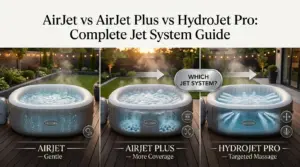
Not sure which SaluSpa jet system fits you best? Here is exactly how AirJet, AirJet Plus, and HydroJet Pro compare on massage strength, price, and upkeep.
Every SaluSpa model runs on one of three jet systems, and honestly, this matters more to your day-to-day experience than almost any other spec on the page. Color, capacity, extra lighting all secondary. The jets are what you actually feel every time you get in. So let’s get into what separates these three, and which one you’d probably be happiest with.
How AirJet Works?
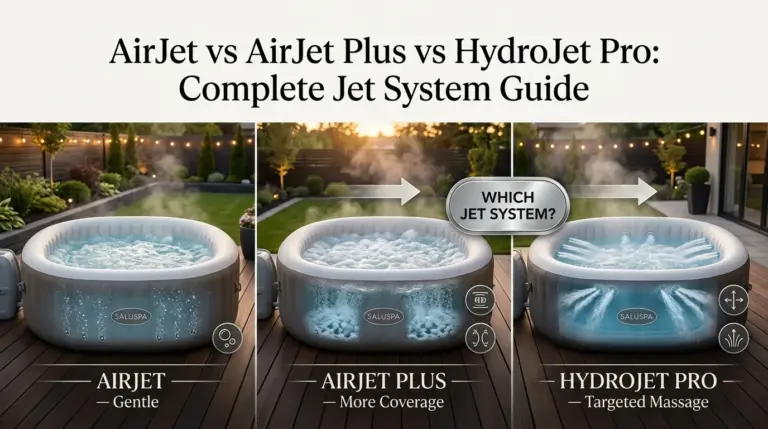
AirJet is the baseline system found across the AirJet hot tub range, and it’s the one most SaluSpa owners end up with. It works by pushing warm air through small openings around the base of the tub, creating a steady stream of fine bubbles across your legs and back. Nothing about it feels forceful it’s closer to a gentle fizz than a massage in the traditional sense.
That gentleness is actually the appeal for a lot of people. If you want to sit back with a drink and unwind rather than get worked over, AirJet does the job without overselling itself.
What AirJet Plus Adds?
AirJet Plus takes the same basic idea and turns the volume up. The AirJet Plus models add a second ring of jets in the center of the base, on top of the usual perimeter jets, so you get bubbles hitting your feet and lower back at the same time as the standard all-around massage. It’s still air, not water, so the sensation is still gentle just more of it, covering more of your body at once.
Think of AirJet Plus as the “I like AirJet but want a bit more” option, rather than a completely different category of massage.
Where HydroJet Pro Changes the Experience?
This is the real jump. The HydroJet Pro lineup keeps the standard AirJet system running underneath, but adds directional water nozzles built into the side walls. Instead of bubbles, you’re getting an actual stream of pressurized water aimed at a specific spot shoulders, lower back, wherever you angle it.
You can usually run the two systems separately or together, which is worth knowing. Some nights you might want the full water massage; other nights, just the gentle AirJet base is plenty. Our Santorini vs St. Moritz comparison covers this exact contrast in more detail, since Santorini runs HydroJet Pro and St. Moritz sticks to standard AirJet.
Side-by-Side Comparison
| Feature | AirJet | AirJet Plus | HydroJet Pro |
|---|---|---|---|
| Massage type | Air bubbles | Air bubbles (dual zone) | Air + directional water jets |
| Intensity | Gentle | Moderate | Strong, targeted |
| Best for | General relaxation | Full-body coverage | Muscle recovery, deep massage |
| Water cooling | Minimal | Minimal | Slightly faster while jets run |
| Maintenance | Low | Low | Slightly more involved |
| Typical price tier | Entry-level | Mid-range | Premium |
Does a Stronger Jet System Cost You Anything?
There’s a small trade-off worth knowing about. Because HydroJet Pro pulls water through the nozzles rather than just air, the water can cool a touch faster while the jets are actively running, and the internal plumbing needs a bit more regular attention to avoid buildup over time. Neither is a dealbreaker, but it’s fair to mention alongside the extra massage strength.
AirJet and AirJet Plus, by comparison, are close to maintenance-free. There’s no standing water in the jet lines, so there’s simply less to think about.
Which One Should You Actually Pick?
If you’re mostly using your hot tub to unwind after work or host casual evenings with friends, standard AirJet covers that completely no need to pay more for intensity you won’t use. If you want that same relaxed feel but spread across more of your body at once, AirJet Plus is a reasonable step up without a big price jump.
HydroJet Pro is worth the extra cost specifically if you’re dealing with regular muscle tension, recovering from workouts, or you just know from experience that gentle bubbles alone don’t cut it for you. Our SaluSpa Ibiza vs Hawaii HydroJet Pro guide is a good next read if you’ve landed on HydroJet Pro and want to compare specific models within that line.
If you’re still weighing capacity and other features alongside jet type, the full SaluSpa models overview walks through the entire range by size and system, which makes narrowing things down a lot easier.
FAQs
Here are some frequently asked questions given below:
What is the difference between AirJet and HydroJet Pro?
AirJet uses warm air pushed through openings around the tub to create a gentle bubble massage. HydroJet Pro adds directional water jets on top of that base system, delivering stronger, more targeted pressure at specific points on your body.
Is AirJet Plus actually stronger than standard AirJet?
Yes, though the difference is in coverage more than raw intensity. AirJet Plus adds a second ring of jets at the base’s center, so more of your body gets hit by bubbles at once, but it’s still an air-based, gentle massage overall.
Which jet system is best for muscle pain relief?
HydroJet Pro is the better choice here. Its directional water jets deliver focused pressure closer to what you’d feel in a traditional hydrotherapy spa, which AirJet and AirJet Plus simply aren’t designed to replicate.
Do HydroJet Pro models need more maintenance than AirJet?
A little, yes. Because water sits in the jet plumbing rather than just air, HydroJet Pro systems benefit from more regular cleaning to prevent buildup. It’s a manageable difference, not a significant burden.
Can I use AirJet and HydroJet Pro at the same time?
On HydroJet Pro models, yes — the standard AirJet base runs independently, so you can combine both systems or run either one on its own depending on what you’re in the mood for that day.
Conclusion
None of these three systems is objectively “the best” they’re built for different kinds of soaking. AirJet suits anyone who wants simple, gentle relaxation without a second thought about maintenance. AirJet Plus is a small step up for people who want more coverage without changing the type of massage. And HydroJet Pro is the pick if targeted, therapeutic pressure is actually what you’re after, with a small trade-off in upkeep that most owners find well worth it.
The right choice really comes down to how you plan to use your hot tub most nights, not which system sounds the most impressive on paper.