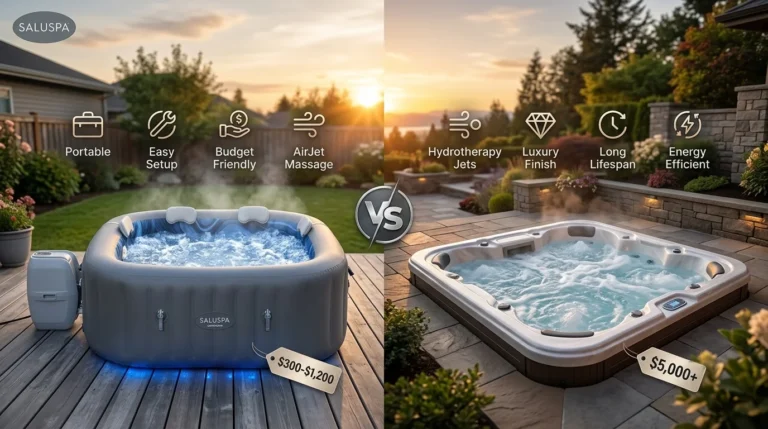
Before buying a hot tub, almost everyone asks the same question first: how much does a hot tub cost? The honest answer depends heavily on whether you’re looking at an inflatable model like SaluSpa or a permanent, built-in unit.
Both can deliver a genuinely relaxing soak. But the price gap between them is bigger than most people expect, and so is the gap in what you’re signing up for long-term. Here’s how they actually compare.
Inflatable Hot Tub Cost vs Built-In Hot Tub Cost
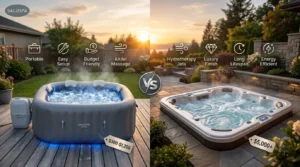
An inflatable hot tub cost typically falls between $300 and $1,200, depending on size and features. That price usually covers the tub itself, a combined heater and pump unit, an insulated cover, a couple of filter cartridges, and a basic repair kit.
A built-in hot tub cost tells a very different story. Even the most basic acrylic models start around $2,000 to $5,000, and mid-range to luxury units with advanced jets, seating, and lighting can run well past $10,000 to $15,000.
So is an inflatable hot tub cheaper than a real hot tub? In upfront terms, yes, by a significant margin. It’s not unusual to see a 10 to 15 times difference between an entry-level SaluSpa and a basic permanent spa.
Hot Tub Installation Cost: Portable vs Permanent
This is where the gap widens even further. A SaluSpa or any similar inflatable model needs no professional installation. You place it on a flat, supportive surface, inflate it, fill it, and plug it into a standard 110–120V outlet.
A traditional built-in hot tub is a different project entirely. Installation costs for a permanent hot tub commonly range from $650 to $6,100, and can climb higher if the job involves excavation, deck construction, or electrical upgrades for a 220V hookup.
If you’re comparing portable hot tub vs permanent hot tub setups purely on hassle and up-front labor, portable wins without much debate.
Running Costs: Are Inflatable Hot Tubs Cheaper to Operate?
Are inflatable hot tubs worth it once you factor in running costs? This is where things get more nuanced.
Inflatable hot tub running costs in Canada tend to be higher per session than people assume, especially through colder months. Most models draw around 1,300 to 1,500 watts while heating, and because they rely on thinner insulation than a built-in unit, they can lose heat faster, meaning the heater cycles on more often.
Built-in hot tubs are usually better insulated and more energy-efficient over time, which can offset their much higher upfront cost the longer you own one. It’s a trade-off: lower purchase price now, versus lower running costs over many years.
Total Cost of Ownership: The Bigger Picture
Total cost of ownership for an inflatable hot tub includes more than the sticker price. Filter cartridges need replacing every one to three months. Chemicals and water treatment add up over a season. Site prep, even for a portable unit, may mean a concrete slab, pavers, or reinforced decking, since a filled tub can weigh well over a ton.
Built-in hot tubs also carry ongoing costs, but their larger filtration systems, superior insulation, and sturdier construction generally mean fewer replacement cycles and a longer gap between major repairs.
Inflatable Hot Tub vs Acrylic Hot Tub Durability
Durability is one area where the difference is hard to ignore. A well-maintained inflatable hot tub typically lasts around 8 years. An acrylic, fiberglass, or wood-shell built-in hot tub, properly maintained, can easily last two to three times longer.
That said, SaluSpa’s DuraPlus material and Freeze Shield technology were built specifically to close some of that gap. DuraPlus construction resists punctures and stretching far better than older inflatable designs, and Freeze Shield automatically protects internal components from freezing during cold snaps, which matters a great deal for Canadian winters.
Jet Pressure: AirJet vs Hydrotherapy Jets
Jet pressure is another honest difference to flag. SaluSpa’s AirJet system releases warm air bubbles for a relaxing, all-over massage. It feels great for everyday unwinding, but it’s not the same as the higher-pressure hydrotherapy jets found in most built-in tubs, which target specific muscle groups with more force.
If deep, therapeutic massage is your main priority, a traditional hot tub still has the edge. If general relaxation is enough, SaluSpa’s AirJet massage covers that comfortably.
Inflatable Hot Tub vs Built-In Hot Tub: Pros and Cons
Inflatable hot tub pros:
- Much lower upfront cost
- No professional installation needed
- Portable — take it with you if you move
- Great for renters or smaller yards
Inflatable hot tub cons:
- Shorter lifespan than built-in models
- Higher running costs relative to size
- Less intense jet pressure
Built-in hot tub pros:
- Longer lifespan and sturdier build
- More powerful hydrotherapy jets
- Better long-term energy efficiency
Built-in hot tub cons:
- High upfront and installation cost
- Permanent — not an option for renters
- Longer setup and construction timeline
Best Hot Tub for a Small Budget
If budget is the deciding factor, an inflatable model like SaluSpa is the clear starting point. It gets you a real hot tub experience without the multi-thousand-dollar commitment, and it’s a low-risk way to find out whether hot tub ownership is even something you’ll use regularly before investing in a permanent one.
Frequently Asked Questions
How much cheaper is an inflatable hot tub than a built-in one? Inflatable models generally cost 10 to 15 times less upfront than a basic built-in hot tub, with SaluSpa units typically priced between $300 and $1,200.
Do inflatable hot tubs cost more to run than traditional hot tubs? Per session, inflatable tubs can cost more to run due to thinner insulation, though the much lower purchase price often offsets this for casual users.
How long do inflatable hot tubs last compared to built-in tubs? A well-maintained inflatable hot tub lasts around 8 years, while built-in hot tubs can last two to three times longer with proper care.
Is a SaluSpa as good as a permanent hot tub? It depends on your priorities. SaluSpa offers strong value, portability, and comfort, but a permanent hot tub still wins on jet intensity and long-term durability.
Do inflatable hot tubs need professional installation? No. SaluSpa hot tubs are designed for simple, tool-free setup on any flat, supportive surface.
What’s the average cost of hot tub installation? Built-in hot tub installation typically runs from $650 to $6,100. Inflatable hot tubs require no professional installation at all.
Conclusion
Choosing between SaluSpa and a traditional built-in hot tub really comes down to what you value most. If low upfront cost, portability, and easy setup matter more to you, an inflatable model is the smarter buy. If you’re set on a permanent fixture with maximum jet pressure and the longest possible lifespan, a built-in hot tub is worth the bigger investment.
For most first-time buyers, though, a SaluSpa offers a genuinely solid middle ground: real relaxation, real durability with DuraPlus and Freeze Shield, and none of the financial risk that comes with a permanent installation.